Showing posts with label Naed Nutrition. Show all posts

Sunday, 25 September 2016

Why Keep a Food Diary?


Being accountable to your food intake can ultimately be the difference between achieving your goal and not achieving your goal. One of the easiest ways to be accountable is to keep a food diary. You can track what you eat, when you eat, when you stick to your plan and when you struggle to.

It is such an amazing tool to keep you on track, conscious of your intake, and watching out for areas you can improve on. It is NOT about making yourself feel bad or pointing out every time you went s stray from the meal plan.
It is all about ACCOUNTABILITY.

How can I keep a food diary?
  • Writing it down on paper or in a journal
  • Using an app on your phone, ipad or laptop (i.e. Doc's Diet Diary)


What do I need to track?
  • How much you eat AND drink– portions in cups or grams
  • What you eat – everything involved writing ‘salad’ is no descriptive enough
  • When you eat – timing is everything with food intake when you eat can affect your progress
  • Why you eat – is it according to your meal plan? Is it because you are bored?


What else should I track on my food diary?
  • Your thoughts/emotions – can help you understand why you make certain food choices
  • Any symptoms you are having – if there is an intolerance? Or fatigue in a training session
  • Your training – to ensure you are fueling your body & staying accountable to your training
  • Supplements & medications – to ensure you are sticking to your regime and timing


Should I share my food diary?
Not on Facebook but to a trusted health & fitness professional that can give you some honest and constructive feedback on how you are going. Making a few small adjustments can be the difference between achieving your goal and not achieving your goal


At Naed Nutrition we offer food diary feedback as part of many of our packages and services however you can choose it on it’s own for only $10 per week: Food Diary Feedback

Wednesday, 15 June 2016

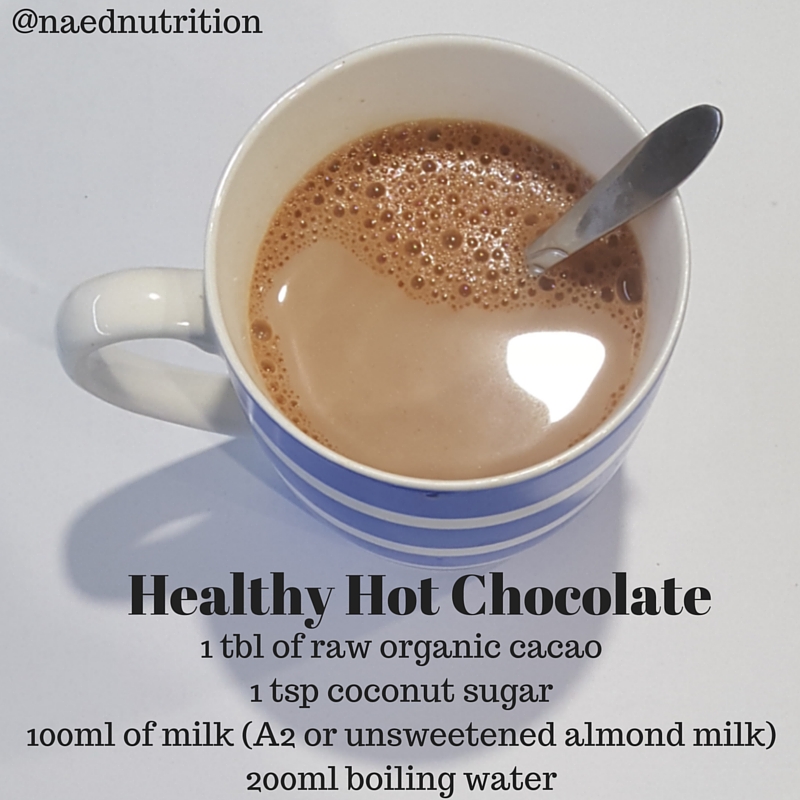
Healthy Hot Chocolate


The winter chill is here & you may be craving particular foods (mostly chocolate) to keep you warm! But why are you having these cravings?

What causes food cravings?
  • Low energy
  • Boredom
  • Poor diet
  • Nutrient deficiencies
  • Stress
  • Depression
  • PMS
  • Insufficient calorie intake
  • Alcohol/Hangover
  • Dealing with emotions
  • Food Intolerances
  • And much more!

Specific chocolate cravings can be more specifically linked with magnesium deficiency.

Foods high in Magnesium
  • spinach
  • broccoli
  • pumpkin seeds
  • sunflower seeds
  • sesame seeds
  • flaxseeds
  • cucumber
  • green beans
  • celery
  • kale
Alternative you can take a magnesium supplement such as Bioceuticals ultramuscleze night or P5P

A great way to satisfy those chocolate cravings is with our Healthy Hot Chocolate recipe

Ingredients
  • 100ml A2 milk (or almond milk)
  • 1 tsp of coconut sugar
  • 1 tbl of raw organic cacao (cacao vs cacao blog post)
  • 200ml boiling water
Method
  • Boil the kettle
  • In a mug add milk, coconut sugar and cacao. Milk thoroughly
  • Add boil water and mix well

Nutrition Information
Servings per package:
1.00

Serving size:
325
ml

Average
Quantity per Serving

Average
Quantity per 100 g

Energy
335
kJ
103
kJ
Calories
80
cal
25
cal
Protein
4.1
g
1.3
g
Fat, total
4.0
g
1.2
g
- saturated
3.1
g
0.9
g
Carbohydrate
6.3
g
1.9
g
- sugars
5.2
g
1.6
g
Sodium
49
mg
15
mg


To find out how to adjust your nutrition intake and reduce cravings contact us at admin@naednutrition.com.au

Friday, 27 May 2016

Top 7 Food Additives to Avoid


Additives are found everywhere in our packaged products but what do those little numbers mean and which ones should you look out for? Here are our top 7 list of food additives to avoid:  

1. Aspartame # 951 C found in Diet Foods & diet soft drinks, equal,
Linked to many health problems including cancer, asthma, nausea, depressions, hyperactivity, seizures.  Causes dizziness, headaches & hallucinations

2. Olestra (Fat substitute) found in chips, crackers (no fat/reduced fat)
Linked to diarrhoea cramps, flatulence, increases appetite, decrease the ability for fat soluble vitamins to be absorbed.

3. Erythrosine #E127 (red) found in jams, sugar lollies, toppings & fillings, red cordials and soups
Linked to concentration issues, increase in hyperactivity in kids, nerve toxin

4. MSG #621 found in Chinese, salad dressings, soups, chips
Linked to Asthma, hyperactivity, depression, mood changes, sleeplessness, nausea, migraine, linked to infertility, teratogen, convulsions, abdominal discomfort. See text re other hidden sources of MSG
Causes headaches, dizziness, migraines, convulsions

5. Sodium Nitrate #251/250 found in Bacon, ham, salami, corned beef, hot dogs
Linked to Hyperactivity, behavioral problems, asthma, headaches, dizziness, possible carcinogen. Prohibited in foods for infants and young children.

6. Sulfites #222/223/228 eg: sodium bisulphite (222) Found in wine, beer and dried fruit
Linked to migraines and asthma attacks in some people

7.  Tartrazine #E102 (yellow) found in lollies, desserts, cereal and soft drinks
Linked to Hyperactivity, behavioral problems, skin rashes, migraines and thyroid problems.

Remember they won’t always be listed under these names or numbers, for example Tartrazine #E102 is listed as FD&C yellow 5 or C.I. 19140. Be consumer aware & download the free app Additive Alert!

For more information on becoming consumer aware with your foods contact us at admin@naednutrition.com.au

Wednesday, 27 April 2016

What is a Nutritionist?

Nutritionists are trained allied health professionals who provide safe, evidence-based dietary and nutritional advice to assist in the management of health and prevention of disease. Poor diet, the ingestion of harsh chemicals and eating foods with a low nutritional value can have a detrimental effect on health, however through correct nutritional advice more diseases can easily be prevented, treated and even cured. It also involves providing advice to clients based on the physiological responses of their body to diet through metabolic pathways (how the energy and nutrients from food is absorbed and used in the human in the body).

Nutrition is focused on the science of nutrients and how they are digested, absorbed, transported, metabolized, stored, and eliminated by the body. Besides studying how food works in the body, nutritionists are interested in how the environment affects the quality and safety of foods, and what influence these factors have on health and disease.


At Naed Nutrition, we know that everyone is different and as such are passionate about personalised nutrition. There is no one size fits all for clean eating, what works for one doesn’t work for some.

Each person has their own goal, their own likes and dislikes with foods, has a different lifestyle, and different health concerns whether it be past or present.

This means that each person receives the nutrition service that will fit them.
Consults will consist of a variety of health, diet and lifestyle related questions with the upmost confidentiality and privacy

We offer a range of personalised services from consults right through to meal plans including as much or as little accountability as required.


Naed Nutrition endeavours to go above and beyond for our clients. For more information of how we can help you achieve your goal simply pop on our website www.naednutrition.com.au or email admin@naednutrition.com.au

Thursday, 3 March 2016

Smoothie Bowl


Smoothie bowls are currently taking over our social media and we have to admit they look delicious! But are these colourful fruit filled bowls actually good for us? At Naed Nutrition we get excited about breakfast, the endless array of options that start your day in a positive way and fuel yourself for the day ahead; smoothies have to be one of our favourites. Smoothies are a fantastic fast and convenient breakfast option especially for those on the go, simply prep and portion your smoothies and freeze in zip lock bags for the week ahead to grab out in morning, blitz and go!

When preparing smoothies limit yourself to one piece or 1/2 -1/4 cup of fruit, try to add some greens like a handful of kale or baby spinach, and add a protein source; whether a scoop of a good quality protein powder (we recommend Boomers Whey Protein Isolate) or 1-2tbs of LSA mix or mixed unsalted nuts and seeds. By adding a protein source to your smoothie you assist to regulate insulin and blood sugar levels, stay fuller for longer, and create a slow release energy that will last you well into morning tea.

A smoothie bowl is essentially a smoothie poured into a bowl topped with an array of fruits, nuts, and seeds. They can be a delicious meal eaten any time of the day filled with an array of nutrients, just ensure you don't add too many toppings as you have already blitzed up your requirements in the smoothie, therefore by adding an additional array of toppings you are essentially adding extra calories that you may not require, depending on your activity level for the day. The recipe below details a smoothie bowl of a healthy portion size!

Ingredients

1 scoop of protein powder
1/4 cup of berries or 1 piece of fresh fruit
2 handfuls of baby spinach or kale
150mL unsweetened unflavoured almond milk
1 tbl natural probiotic yogurt

1 tsp of chia seeds
1 tsp flax seeds
1 tsp roughly chopped walnuts

Directions

Blend protein powder, berries/fruit, spinach/kale, unsweetened almond milk and yogurt in a blender until smooth. Pour into a bowl and top with chia seeds, flax seeds and walnuts. Enjoy!


Thursday, 4 February 2016

Grain Free Cracker Recipe


It can be difficult to find crackers that are high in fibre and protein while low in sodium, but this recipe has the perfect balance of goodness! These crackers are grain free as they do not contain any flour and are also vegan with no milk or eggs, therefore they are a perfect gluten free, diary free and vegan alternative.   High in protein and essential fatty acids from the addition of linseed, almonds, sunflower, chia and sesame seeds, these crackers make a perfect healthy snack either eaten alone or with some home made hummus or avocado dip.


Ingredients

1 tbsp Chia seeds
60g Water
140g Almonds
15g Linseed – flax seed
30g Sunflower seeds
¼ tsp Himalayan sea salt
½ tsp Garlic powder
¼ or ½ tsp Chilli flakes
2 tbl Sesame seeds

Directions

Mix chia seeds with water in a bowl and allow to stand for approximately one hour. Preheat oven to 170°c and line a baking tray with non–stick baking paper.
Place almonds, linseed, sunflower seed, Himalayan sea salt, garlic powder, and chilli flakes into a food processor and process on high until small crumbs form. Add soaked chia seeds, which will now have a gel like consistency, and process on high until a dough forms, scrapping the sides if needed.
Using a spatula scrape the dough onto a sheet of non-stick baking paper, and place an additional sheet on top to prevent the rolling pin from sticking. Roll the dough to 2-3mm thickness. Remove the top sheet of baking paper and sprinkle dough with sesame seeds, gently pressing the seeds into the dough to ensure they stick. Using a bread knife or pizza cutter gently score the dough into cracker shapes approximately 4-5cm in length and spread apart to ensure the crackers are cooked evenly.
Bake in preheated oven for 15 minutes or until golden brown.  Remove from oven and place on a cooling rack and allow to cool completely before serving.

Saturday, 16 January 2016

Zesty Salmon & Roasted Beets Recipe


Summer is upon us and this means its salad season! Zesty salmon fillets atop a fresh spinach salad with wholesome roasted beets sounds like summer to us at Naed Nutrition, and we want to share this delicious recipe to get you excited about fish and fresh produce!

Many of us rarely eat our recommended 2-3 servings of fish a week, and many of us find it difficult to create recipes that incorporate fish. At Naed Nutrition we regularly receive comments from clients that they don't like fish or have tried it and couldn't stand the 'fishy' taste. Don't give up!  a fresh fillet of fish should in no way smell or taste fishy, the key is to buy fresh produce from your local market, grocer or fish monger.

Fresh fish, especially salmon, mackerel, sardines and even tuna can provide you with omega 3 fatty acids, specifically EPA & DHA.  Eicosapentaenoic acid (EPA) lowers blood pressure, prevents blood clott formation, protects against irregular heart beats, and reduces inflammation. While Docosahexaenoic acid (DHA), is essential for the central nervous system, brain development and normal brain function. Regular intake of omega 3 fatty acids will help to reduce joint pain, arthritis, inflammation and assist to maintain cardiovascular and brain health. Regular consumption of fish can assist to improve your health in a number of ways, therefore give this recipe a try!

Ingredients

4 small fresh beetroots, around 200g
1tbs extra virgin olive oil
1 tsp coriander seeds, lightly crushed
2 skinless salmon fillets
2 small oranges, zest of 1 and juice of ½ 
3tbs pumpkin seeds
1 garlic clove
1 red onion, finely chopped
4 handfuls of baby spinach
1 avocado, thickly sliced

Directions 

Preheat oven to 180 C, 160C fan. Trim the stems of the beetroot and reserve any tender leaves that are suitable for eating in the salad. Cut the beetroots into quarters then toss with ½ tbsp oil, the coriander seeds, and some seasoning then pile into the centre of a large sheet of foil and wrap up like a parcel. Bake for 45 minutes or until the beetroots are tender then top with the salmon, scatter over half the orange zest and return to the oven for 15 mins. If you want to toast the pumpkin seeds, put them in the oven for 10 minutes.

Meanwhile, cut the peel and pith from 2 oranges then cut out the segments with a sharp knife working over a bowl to catch the juices. Finely grate the garlic and leave for 10 minutes to allow the enzymes to activate. Stir the garlic into the orange juice and remaining oil with seasoning to make a dressing.

Remove the parcel from the oven and carefully lift off the fish. Tip the beetroot into a bowl with the red onion, remaining orange zest, pumpkin seeds and spinach leaves and toss well. Gently toss through the orange segments and avocado with any remaining beet leaves, then pile onto plates and top with the warm salmon. Drizzle over the dressing and serve.

Thursday, 24 December 2015

New Year - New You! 5 Steps to Setting Goals in the New Year


Our amazing friend and affiliate at Insite Mind; Alisa Illich has put together a 5 step plan to set new goals for the new year. At Naed Nutrition we encourage the clean slate the new year brings, which allows us to forgive and forget the bad habits we had in the year that has past, and create new and healthy habits for the year to come!

Step 1: Understand what feeling stuck looks like

We often feel frustrated, regretful and depressed about the past, but we need to feel excited and inspired by the future! The first step to becoming unstuck is to take a step in the right direction and create action, therefore moving forward.

Step 2: Identify where you would like to create a goal

Have a think about what goal you would like to set for the new year. There are many areas in our lives that we feel stuck particularly around nutrition:
  • Weight loss
  • Health
  • Wellness
  • Fitness
  • Mindset

For each of the aspects you have connected with, do you feel stuck in the past or the future? Examples could be as simple as regretting that slice of cake you ate for dessert last night, or opting for a sleep in rather than getting up early for your morning run. Perhaps you are unstuck in future, not knowing how fulfil a desire to become healthier in the future.

Step 3: Alignment

Before we can take action to move forward in the areas we stuck in we must first align ourselves. This means we must get into the right head space and become inspired to make decisions and create actions. We can do this by:
  • Meditation
  • Appreciation
  • Breathing
  • Affirmations
  • Exercise
What are you going to commit to in order to move your energy into the right space before moving onto the next step? 

Step 4: Setting Goals

A useful way of creating powerful goals is through the use of the acronym SMARTIES..

S - Specific
M - Measurable
A - Achievable 
R - Realistic
T - Time Bound
I - Inspirational
E - Emotional 
S - Success

Create a goal for the areas you identified in step 2. Examples could be to increase your exercise, lose weight in the new year, feel healthier or improve your health.

Step 5: Create an action plan


What am I currently doing to achieve my goal?

What are the things I need to be doing to achieve my goal?
What are some of the challenges I may face?
How am I going to overcome these challenges?
What actions am I going to commit to, to achieve my goal?

For example, rather than planning to meet your friends and family for lunch or coffee, plan to meet for a walk, or have a picnic at the park.

If you plan to eat healthier, write a shopping list to avoid purchasing unwanted unhealthy items and avoid ordering take away.

If you have a weight loss goal for the new year contact Naed Nutrition to discuss how we can help you achieve the,.
If you require additional assistance in setting goals and shifting your mindset contact Insite Mind 


Wednesday, 18 November 2015

Moroccan Zucchini & Chick Pea Salad


This Moroccan inspired salad is hearty and satisfying. A fantastic side to any meal or even eaten alone, this recipe is sure to become one of your favourites!

Zucchini's are certainly the highlight of this dish, offering a hearty and wholesome texture. Zucchini's are often used as a meat alternative that delivers protein, folate, potassium, phosphorus, magnesium, vitamin C, plus many more! The addition of chick peas to the following dish ensures satiety, while alike other legumes and pulses acts to assist cardiovascular and digestive health.

Serves 4 - 6
Preparation & cook time  ~ 20 minutes

Ingredients

2 zucchini's
2 - 3 tbls extra virgin olive oil
400g can chickpeas, drained and rinsed
Bunch fresh coriander, roughly chopped
1 red onion, finely chopped


1tsp paprika
1tsp ground cumin
1tsp organic local honey
Juice of 1 fresh lemon
4 tbls extra virgin olive oil

Method

1. Slice each zucchini length ways into thick slices, and arrange over a grill pan on medium heat. Lightly brush either side of the zucchinis slices with extra virgin olive oil, and sprinkle with a pinch of pink himalayan sea salt and freshly cracked black pepper. Cook until tender for around 8-10 minutes. When cooked, remove from the grill pan and cut each slice into quarters.

2. Place grilled zucchini quarters and can of drained and rinsed chickpeas into a bowl. Add fresh coriander and red onion.

3. To make the dressing add paprika, cumin, honey, lemon juice and extra virgin olive oil into a clean jar, place on the lid and shake well. Once combined, pour over zucchini and chickpea mix, and toss to combine. Serve and enjoy