Showing posts with label healthy. Show all posts

Wednesday, 15 June 2016

Healthy Hot Chocolate


The winter chill is here & you may be craving particular foods (mostly chocolate) to keep you warm! But why are you having these cravings?

What causes food cravings?
  • Low energy
  • Boredom
  • Poor diet
  • Nutrient deficiencies
  • Stress
  • Depression
  • PMS
  • Insufficient calorie intake
  • Alcohol/Hangover
  • Dealing with emotions
  • Food Intolerances
  • And much more!

Specific chocolate cravings can be more specifically linked with magnesium deficiency.

Foods high in Magnesium
  • spinach
  • broccoli
  • pumpkin seeds
  • sunflower seeds
  • sesame seeds
  • flaxseeds
  • cucumber
  • green beans
  • celery
  • kale
Alternative you can take a magnesium supplement such as Bioceuticals ultramuscleze night or P5P

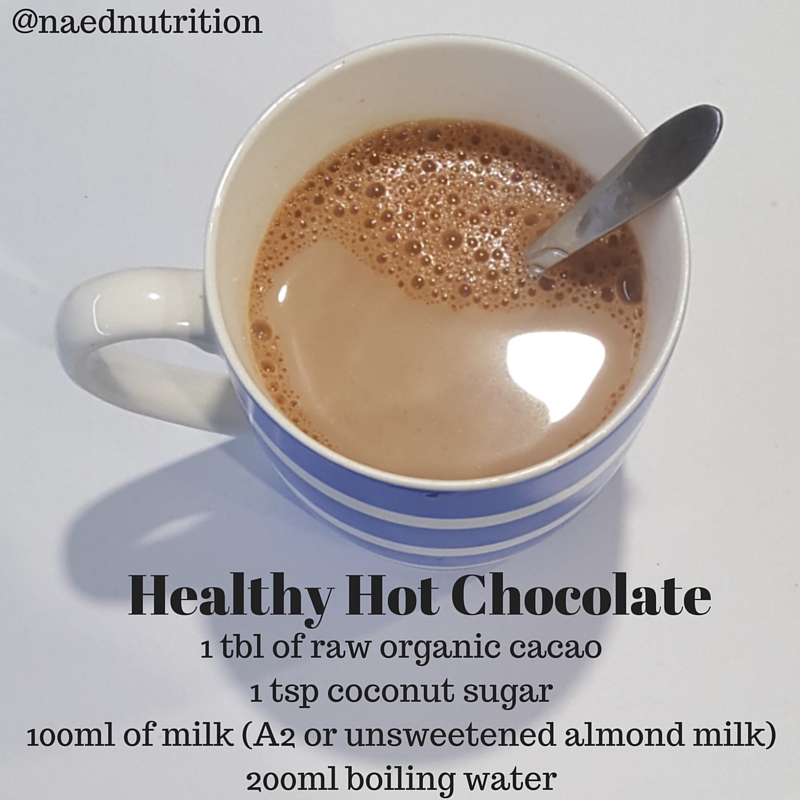
A great way to satisfy those chocolate cravings is with our Healthy Hot Chocolate recipe

Ingredients
  • 100ml A2 milk (or almond milk)
  • 1 tsp of coconut sugar
  • 1 tbl of raw organic cacao (cacao vs cacao blog post)
  • 200ml boiling water
Method
  • Boil the kettle
  • In a mug add milk, coconut sugar and cacao. Milk thoroughly
  • Add boil water and mix well

Nutrition Information
Servings per package:
1.00

Serving size:
325
ml

Average
Quantity per Serving

Average
Quantity per 100 g

Energy
335
kJ
103
kJ
Calories
80
cal
25
cal
Protein
4.1
g
1.3
g
Fat, total
4.0
g
1.2
g
- saturated
3.1
g
0.9
g
Carbohydrate
6.3
g
1.9
g
- sugars
5.2
g
1.6
g
Sodium
49
mg
15
mg


To find out how to adjust your nutrition intake and reduce cravings contact us at admin@naednutrition.com.au

Monday, 3 August 2015

Traditional VS Quick Oats

As nutritionists we LOVE oats, they taste delicious with a pinch of cinnamon and a drizzle of honey especially on those cold winter mornings. Clients are often surprised when we recommend a bowl of hearty porridge for breakfast, but we explain that oats are packed with nutritional goodies! Oats are high in protein to keep you fuller for longer and provide your body with building blocks for life. A rich source of both soluble and insoluble fibre oats can assist gastrointestinal health, along with supporting cardiovascular health to help mop up excess cholesterol and glucose in the digestive tract. Oats are also powerful antioxidants, and have anti-inflammatory properties that can help to reduce the formation of atherosclerotic plaques in arteries, therefore reducing risks of cardiovascular disease. They also assist to maintain blood sugar levels in diabetics, and scientific evidence has found consumption of oats can improve immune health, protect against cancer formation, and assist in the management of body weight and childhood asthma. Further more, oatmeal can be used topically as an anti inflammatory lotion for the relief of dry itchy skin from dermatitis, and chemotherapy induced rash.

The question is, which oats do you buy? From steel cut to quick oats, the table below lists a number of common oats available in your local supermarket, and compares their nutritional value and cost. Steel cut oats are wholegrains with the outer husk removed and cut into smaller pieces, they are rich in bran and germ meaning they are an excellent source of fibre beneficial for gastrointestinal and cardiovascular health. Similarly, traditional and quick oats are also high in fibre and are your cheapest option at the super market the only difference between them is that quick oats are chopped for a quicker cooking time. The price of oats rises as you begin to choose sachets and flavours, which are also accompanied by a rise in sodium and refined sugars. Original sachets are basically quick oats in a convenient sachet form, but cost almost 3x the price per 100g. Quick High Fibre sachets have the highest fibre profile compared to all oats available on the market, but also have the highest sodium quantities and price. Lastly, quick brown sugar and cinnamon sachets have the lowest protein and fibre amounts, accompanied with high sugar profiles.


Nutrients per 100g
Variety of Oats
Cost per 100g
Protein
Total Fibre
Beta Glucan
Soluble Fibre
Insoluble Fibre
Sodium
Steel Cut
0.88
12.8
9.7
4
4
5.7
12mg
Traditional
0.55
12.8
9.2
4.5
4
5.7
6mg
Quick
0.55
12.8
9.7
4
4
5.7
12mg
Quick Sachet –Original
1.44
12.8
9.7
4
4
5.7
12mg
Quick Sachet – Hi Fibre
1.51
10.9
15
3
4.9
10.1
41mg
Quick Sachet –Brown Sugar & Cinnamon
1.44
9.9
7.8
-
-
-
11mg

In conclusion, traditional oats are your best option, they are high in protein and fibre and low in sodium and refined sugars, to add additional fibre simply top with a teaspoon each of chia seeds and ground flax seeds, and a touch of organic local honey or fresh fruit to sweeten.

Sarah Campbell


Tuesday, 29 May 2012

Egg-sposed : Myths & Facts

Are eggs good for you? Are they bad for you? How many is too much? Can I only eat egg whites?

These are things I hear on a regular basis & there is so much misinformation about eggs so I’m going to start clearing it up!

Egg stats
  • a large whole egg contains roughly 6g of protein 
  • contains choline (essential for cell membrane function, neurotransmission, prevents homosycstine build up), lutein (essential for eye & skin health) and zeaxanthin (carotenoid important for vision) 
  • contains just about every vitamin and most minerals (except vitamin C)

Myth: Eating eggs raises your cholesterol levels.
Truth Dietary cholesterol found in eggs has little to do with the amount of cholesterol in your body. Roughly ¼ of your body's blood cholesterol comes from your diet and the other ¾ of blood cholesterol is produced by your body. In fact Saturated and trans fats have much bigger effects on blood cholesterol levels. Studies show that people with high cholesterol, eating one egg a day, have shown no increase in their body’s cholesterol levels.  

Myth: Eggs are better stored on the bench top for better cooking results
Fact: Refrigerating eggs reduces the risk of salmonella & keeps them fresh

Myth: Raw eggs have more protein than cooked eggs
Fact: A large egg contains 6g of protein served raw OR cooked
Fact #2: Cooked eggs have 40% more protein than raw because Biotin (found in eggs yolks) is a b complex vitamin essential for cell growth, the metabolism of fats, and energy production. Raw eggs eliminates biotin because of avidin (found in egg whites) is a biotin binding protein when consumed in its raw form, thus cooking the egg avoids the possibility of biotin deficiency.  

Myth: Egg whites have more protein & nutrients than whole eggs
Fact: FALSE!!!! Egg whites less protein than compared with a whole egg, most of the sodium and very little of anything else. Egg yolks are one of the most nutritious foods known to man! They contain almost all vitamins & minerals our diets require (minus Vitamin C). The whole egg is ALWAYS better from a nutritional point of view, period.


Whole egg (per 100g) Egg White (per 100g)
Protein 12.4g 11.6g
Energy 583kJ 204KJ
Fat 9.5g 0g

Myth: One egg every day too much
Fact: FALSE; majority of people can’t have too many eggs. Those with significantly high cholesterol would be limited to one a day. Eggs are an amazing source of protein & nutrients that our bodies thrive on.

Great ways to have eggs:
  • boiled as a snack 
  • scrambled with smoked salmon, spinach tomato & mushrooms for breakfast 
  • frittata with vegetables & a side of salad as a quick dinner
  • omelette packed full of your favourite vegetables at any meal

If you are struggling to get enough protein in your diet contact us at admin@naednutrition.com.au