Showing posts with label nutritionist perth. Show all posts

Thursday, 5 January 2017

Getting Back To Basics

Nutrition is the science of nutrients and how they are digested, absorbed, transported, metabolized, stored, and eliminated by the body. This means what you eat will affect your health, how much fat you lose, how much muscle you can gain, how energetic you feel and so much more.
Here are Naed Nutrition’s top tips to improving your health & wellbeing
Keep hydrated: water is important for
Boosting energy & Aiding the absorption of water soluble nutrients
Elimination of toxins which is needed for  WEIGHT LOSS and for fat metabolism,
Joint mobility & Improving cognitive function
You need to eat fat to burn fat. When you are wanting to burn body fat and lose weight you want to focus on the unsaturated fats such as monounsaturated fatty acids (MUFA’s) and polyunsaturated fatty acids (PUFA’s). 
MUFA’s : olive oils, avocado’s nuts & seeds
PUFA’s (Omega 3’s): fish, nuts, seeds & algae
Eat High protein foods as they allow the body to burn fat by satiety. It allows you to limit excessive carbohydrate intake by keeping you full, controlling appetite, levelling blood sugar levels and increasing metabolism. Protein is found in:
Red meat, poultry, fish, eggs, nuts, seeds, beans and legumes
Eat Carbohydrates in moderation. Carbohydrates are important for burning fat. Good carbohydrate sources are
Fruits, vegetables, whole grains, rice, seeds, legumes and sweet potato
Removed Refine Sugars: white breads, pasta, sugar, lollies (adding to coffee, tea, cereal); these highly refined sugars spike insulin levels and eventually feel you leaving low on energy, depletes essential nutrients from your body, affects your liver and promotes weight gain.
1 x treat per week: If you’re 100% focused on clean eating & weight loss, don’t convince yourself that a ‘treat’ more than once a week is ok. A treat can be anything from chocolate, to alcohol, to a big pasta meal. Once a week until you get to your goal is enough to keep you focused on your goal without depriving yourself, your goal is bigger than that block of chocolate!
Increase your veg: for most people this is the most difficult and here are some helpful hints
Cut up carrot and celery to snack munch on during the day
Make a fruit salad or have a piece of fruit as a snack
Make a stir fry with veggies you don’t normally eat
Try a Green smoothie
Add an extra cup of salad to lunch & an extra cup of vegetables to dinner
Plan & Organise your food:
Plan you meals AND snacks AND include the weekend: Write it down from Monday to Sunday, breakfast through to Supper, every meal & you want to eat. A common mistake people make is forgetting to plan their food for the weekend as well as during the week
Prep what you like with lots of variety: If you don’t like cooking & freezing meals you don’t have to, your prep can be portioning out your meats & protein, cutting & washing & separating all your veggies for the week. You will be amazed at how much time you will save during the week
Portion control: Just because you have cooked up 1kg of chicken that is to die for doesn’t mean you eat it all in a day: portion out the correct portion and spread it out to get the best variety
If you need more help with your nutrition contact sinead@naednutrition.com.au

Wednesday, 15 June 2016

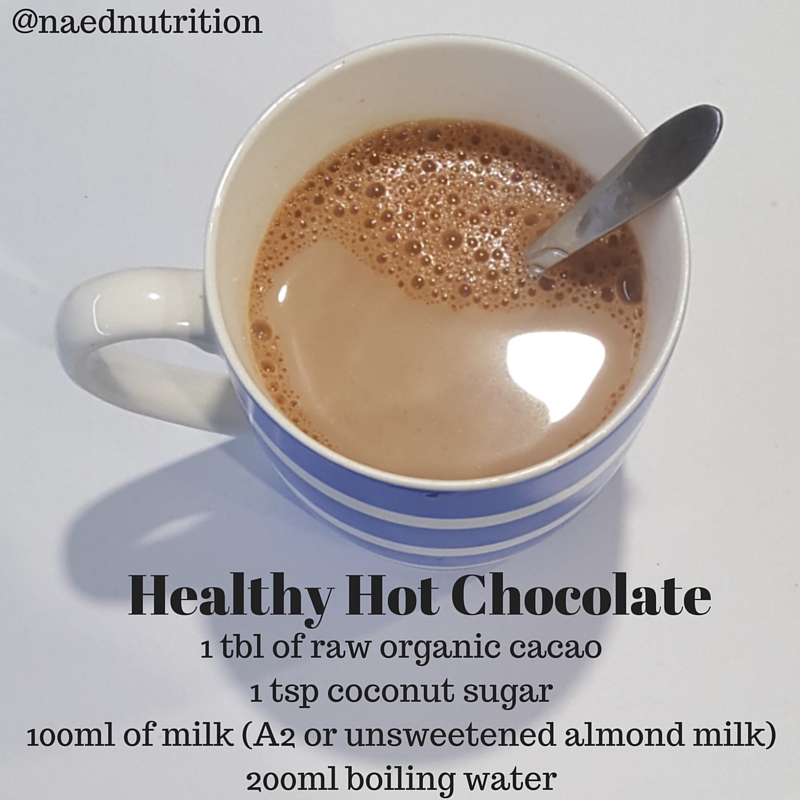
Healthy Hot Chocolate


The winter chill is here & you may be craving particular foods (mostly chocolate) to keep you warm! But why are you having these cravings?

What causes food cravings?
  • Low energy
  • Boredom
  • Poor diet
  • Nutrient deficiencies
  • Stress
  • Depression
  • PMS
  • Insufficient calorie intake
  • Alcohol/Hangover
  • Dealing with emotions
  • Food Intolerances
  • And much more!

Specific chocolate cravings can be more specifically linked with magnesium deficiency.

Foods high in Magnesium
  • spinach
  • broccoli
  • pumpkin seeds
  • sunflower seeds
  • sesame seeds
  • flaxseeds
  • cucumber
  • green beans
  • celery
  • kale
Alternative you can take a magnesium supplement such as Bioceuticals ultramuscleze night or P5P

A great way to satisfy those chocolate cravings is with our Healthy Hot Chocolate recipe

Ingredients
  • 100ml A2 milk (or almond milk)
  • 1 tsp of coconut sugar
  • 1 tbl of raw organic cacao (cacao vs cacao blog post)
  • 200ml boiling water
Method
  • Boil the kettle
  • In a mug add milk, coconut sugar and cacao. Milk thoroughly
  • Add boil water and mix well

Nutrition Information
Servings per package:
1.00

Serving size:
325
ml

Average
Quantity per Serving

Average
Quantity per 100 g

Energy
335
kJ
103
kJ
Calories
80
cal
25
cal
Protein
4.1
g
1.3
g
Fat, total
4.0
g
1.2
g
- saturated
3.1
g
0.9
g
Carbohydrate
6.3
g
1.9
g
- sugars
5.2
g
1.6
g
Sodium
49
mg
15
mg


To find out how to adjust your nutrition intake and reduce cravings contact us at admin@naednutrition.com.au

Wednesday, 4 May 2016

Cacao VS Cocoa


Cacao, Cocoa - same same but different right? Not quite and here is why...


Cacao
Cocoa
What is?

Cacao is a raw superfood that comes from cacao beans. It is the purest form
Cocoa is cacao, roasted

What nutrients is it high in?
Antioxidants
Magnesium
Iron
Potassium
Zinc
Healthy fats
Fibre
Protein
Less of each nutrient when compared to cacao particularly fibre and healthy fats
Pros
Promotes cardiovascular health
Improves mood
Reduces insulin resistance
Very high source of antioxidants
Excellent source of nutrients
Slightly less health benefit due to heating procedure
Cons
Bitter and rich in flavour
Mostly teamed with high sugar, milk fats, hydrogenated oils and artificial flavourings in products
Most common forms
Powder
Nibs
Butter
Powder


Which one do I pick?
The rawest form of the food is the best option. When making your own hot chocolates, smoothies, protein balls or dessert the raw cacao (organic if you can) is your best option in terms of health, longevity and a fat loss. Majority of cheap cocoa powders are going to be teamed with sugars. When choosing an item premade your cacao is always going to be better – just be sure to check what it is teamed with (hydrogenated oils/ sugars etc.)

Need a healthy chocolate fix? Try our Crunchy Protein Balls recipe


Naed Nutrition - Find us on Facebook

Wednesday, 27 April 2016

What is a Nutritionist?

Nutritionists are trained allied health professionals who provide safe, evidence-based dietary and nutritional advice to assist in the management of health and prevention of disease. Poor diet, the ingestion of harsh chemicals and eating foods with a low nutritional value can have a detrimental effect on health, however through correct nutritional advice more diseases can easily be prevented, treated and even cured. It also involves providing advice to clients based on the physiological responses of their body to diet through metabolic pathways (how the energy and nutrients from food is absorbed and used in the human in the body).

Nutrition is focused on the science of nutrients and how they are digested, absorbed, transported, metabolized, stored, and eliminated by the body. Besides studying how food works in the body, nutritionists are interested in how the environment affects the quality and safety of foods, and what influence these factors have on health and disease.


At Naed Nutrition, we know that everyone is different and as such are passionate about personalised nutrition. There is no one size fits all for clean eating, what works for one doesn’t work for some.

Each person has their own goal, their own likes and dislikes with foods, has a different lifestyle, and different health concerns whether it be past or present.

This means that each person receives the nutrition service that will fit them.
Consults will consist of a variety of health, diet and lifestyle related questions with the upmost confidentiality and privacy

We offer a range of personalised services from consults right through to meal plans including as much or as little accountability as required.


Naed Nutrition endeavours to go above and beyond for our clients. For more information of how we can help you achieve your goal simply pop on our website www.naednutrition.com.au or email admin@naednutrition.com.au

Monday, 15 February 2016

School Lunch Box Ideas


Its back to school for the kids and your stuck for healthy lunch box ideas! No need to stress as Naed Nutrition have put together a few tips to help you spruce up your kids lunch boxes, and provide them with the nutrition they need to keep up their concentration and energy levels for day. 

  • Think healthy snacks for morning and afternoon tea. Provide your kids with a snack they can eat quickly, as they will often leave food if it takes too long to eat and takes up their play time. Quick and healthy snacks include; cut up vegetable sticks filled with dip (celery, carrot, cucumber, capsicum, snow peas),  baby quiches, wholemeal picklets, wholemeal fruit muffin, rice cakes and avocado, cold chicken breast pieces, cold chicken drumsticks, cheese cubes, boiled egg,  natural yoghurt, cheese and fruit skewers and cut up fruit pieces.
  • Ensure your kids lunch is comprised of protein, healthy fats and complex carbohydrates. Children require additional needs compared to adults for growth and development therefore they require a nutrient packed lunch that will keep them energised for the afternoon. Some sandwich options include  lean turkey breast and salad, tuna and salad, roasted vegetables and salad. When making sandwiches always use a multigrain or wholemeal bread, try using hummus or avocado as a replacement for butter or margerine, and fill with salad to ensure your children are getting enough greens. Other lunch ideas include frittatas, cold wholemeal pesto, wholemeal pitta pockets, wholemeal roasted vegetable pizzas and multigrain wraps.
  • Get your children involved in making their lunches. Aim to get the kids involved in packing or creating their lunch; they are more likely to eat something they have made themselves. Plan to make some mini quiches, fritters or boil some eggs together on the weekend. 
  • Get creative! Children are attracted to colourful shapes and characters. Cut their sandwiches into fun shapes, include colourful fruits like berries and cherry tomatoes. Place foods onto skewers to create a fun lunch experience.
  • Variety is key to keep your children interested. Having the same lunch everyday is boring for adults let alone children, therefore swap us fruits and vegetables, wraps and sandwiches, shapes and colours to keep children interested. Variation is also  important for nutrition to provide a variety of vitamins and minerals, and ensure your children have access to all the nutrients they require for growth and development.
  • Always pack a colourful water bottle!  Avoid juice boxes, fruit juices, cordials or flavoured drinks as many can cause a sugar rush and hyperactivity in children. High sugar juices and meals can also cause tooth decay in children, therefore by avoiding sugary drinks and encouraging children to drink water with their meals, children can avoid an increased susceptibility to tooth cavities. Flavour water with fruits such as berries or apple pieces, lemon or lime wedges and encourage children to drink water throughout the day to aid digestion, hydration and energy production.


Thursday, 4 February 2016

Grain Free Cracker Recipe


It can be difficult to find crackers that are high in fibre and protein while low in sodium, but this recipe has the perfect balance of goodness! These crackers are grain free as they do not contain any flour and are also vegan with no milk or eggs, therefore they are a perfect gluten free, diary free and vegan alternative.   High in protein and essential fatty acids from the addition of linseed, almonds, sunflower, chia and sesame seeds, these crackers make a perfect healthy snack either eaten alone or with some home made hummus or avocado dip.


Ingredients

1 tbsp Chia seeds
60g Water
140g Almonds
15g Linseed – flax seed
30g Sunflower seeds
¼ tsp Himalayan sea salt
½ tsp Garlic powder
¼ or ½ tsp Chilli flakes
2 tbl Sesame seeds

Directions

Mix chia seeds with water in a bowl and allow to stand for approximately one hour. Preheat oven to 170°c and line a baking tray with non–stick baking paper.
Place almonds, linseed, sunflower seed, Himalayan sea salt, garlic powder, and chilli flakes into a food processor and process on high until small crumbs form. Add soaked chia seeds, which will now have a gel like consistency, and process on high until a dough forms, scrapping the sides if needed.
Using a spatula scrape the dough onto a sheet of non-stick baking paper, and place an additional sheet on top to prevent the rolling pin from sticking. Roll the dough to 2-3mm thickness. Remove the top sheet of baking paper and sprinkle dough with sesame seeds, gently pressing the seeds into the dough to ensure they stick. Using a bread knife or pizza cutter gently score the dough into cracker shapes approximately 4-5cm in length and spread apart to ensure the crackers are cooked evenly.
Bake in preheated oven for 15 minutes or until golden brown.  Remove from oven and place on a cooling rack and allow to cool completely before serving.

Thursday, 17 December 2015

Christmas Leftovers


We are often left with an expanse of leftovers after christmas dinner, which we often throw away or eat unwisely for the next few days, even weeks. Naed Nutrition have put together a few tips and tricks to help you use up those leftovers in healthy and smart ways!

  • First of all, plan and prepare! Talk to your butcher, fish monger, fruit & veg grocer, and ask family and friends to RSVP to your Christmas and New Year events, this way you don't waste money and preparation time from buying too much food.
  • Use everything! Nothing has to go to waste when it comes to carving up your Christmas ham or turkey. Keep and freeze the turkey carcus and ham bones to later make a hearty and healthy stock which can be used for an array of healthy recipes including soups, risottos, poaching etc. You can also freeze leftover slices and pieces of meat, ensuring you put them in a sealable container to later use in soups and lasagnes. Use all leftover cooking juices to make your own gravy, this way you avoid powdered gravies such as Grovox, that are high in salt, additives and preserves, plus the flavour of a home made gravy outweighs any pre-packaged variety.

Think healthy leftovers! 


  • Turkey roll ups. Simply place sliced cucumber, capsicum, carrot and avocado in a slice of fresh turkey and roll it up. A simple and absolutely delicious snack that is high in protein, healthy fats, vitamins and minerals!
  • Frittata. Use leftover rated vegetables and meat to make a healthy frittata. Simply place vegetables and meat in a ovenproof tray and cover with beaten eggs, bake until brown. This healthy recipe can be cut into squares and eaten alone as a snack or with a side of fresh salad for lunch, helping you to reach your 5 a day!
  • Salads. Use lean cuts of turkey, ham and even seafood in salads to add protein and keep you fuller for longer. Eating light salads and avoiding the leftover bread rolls and gravy will help you to feel light over the holiday season.

We hope you have a wonderful Christmas & a Happy New Year!
Naed Nutrition


Wednesday, 18 November 2015

Moroccan Zucchini & Chick Pea Salad


This Moroccan inspired salad is hearty and satisfying. A fantastic side to any meal or even eaten alone, this recipe is sure to become one of your favourites!

Zucchini's are certainly the highlight of this dish, offering a hearty and wholesome texture. Zucchini's are often used as a meat alternative that delivers protein, folate, potassium, phosphorus, magnesium, vitamin C, plus many more! The addition of chick peas to the following dish ensures satiety, while alike other legumes and pulses acts to assist cardiovascular and digestive health.

Serves 4 - 6
Preparation & cook time  ~ 20 minutes

Ingredients

2 zucchini's
2 - 3 tbls extra virgin olive oil
400g can chickpeas, drained and rinsed
Bunch fresh coriander, roughly chopped
1 red onion, finely chopped


1tsp paprika
1tsp ground cumin
1tsp organic local honey
Juice of 1 fresh lemon
4 tbls extra virgin olive oil

Method

1. Slice each zucchini length ways into thick slices, and arrange over a grill pan on medium heat. Lightly brush either side of the zucchinis slices with extra virgin olive oil, and sprinkle with a pinch of pink himalayan sea salt and freshly cracked black pepper. Cook until tender for around 8-10 minutes. When cooked, remove from the grill pan and cut each slice into quarters.

2. Place grilled zucchini quarters and can of drained and rinsed chickpeas into a bowl. Add fresh coriander and red onion.

3. To make the dressing add paprika, cumin, honey, lemon juice and extra virgin olive oil into a clean jar, place on the lid and shake well. Once combined, pour over zucchini and chickpea mix, and toss to combine. Serve and enjoy

Monday, 10 August 2015

Traditional vs Microwave Rice

Brought to Australia around 1850 by Chinese gold prospectors, rice has become a staple of our diet. Their varieties continue to expand as we as consumers demand convenience and nutritional value, from microwave steamed rice to wild black rice, there is an expanse of rice varieties to choose from in your local super market that offer different textures, taste and nutritional value. The table below summarizes some common rice varieties and details their cost and nutritional value.

Variety of Rice
Cost per 100g
Nutrients per 100g


Protein
Carbohydrate
Fibre
Potassium
Magnesium
Niacin
Sodium
Brown
0.32
7.6
72.5
3.9
266mg
111mg
6.4mg
<0.5mg
Microwave
Brown
1.32
4
34
3
130mg
52mg
1.2mg
<5mg
Jasmine
0.32
7.2
78.8
<1
78mg
0
0
<5mg
Microwave Jasmine
1.32
2.9
33.5
<1
9mg
0
0
<5mg
White
0.25
6.8
79.1
<1
82mg
0
0
<5mg
Microwave
White
1.32
3
39
<1
47mg
0
0
<5mg
Brown Rice & Lentils
0.47
10.2
68.4
6.4
342mg
108mg
5.6mg
<5mg
White Rice & Quinoa
0.47
9.1
70.3
4.7
313mg
134mg
2.7mg
<5mg
Wild Rice Mountain Blend
1.10
8.2
74.4
4.1
207mg
117mg
2.7mg
<5mg


Rice can be a healthy alternative to refined carbohydrates and when high in fibre and minerals acts as a hearty addition to any lunch or dinner. Brown and wild rice have the best nutritional value in term of total fibre, protein and minerals and brown rice is one of the cheapest options coming in at 32 cents per 100g, which can be mixed with quinoa and black rice to add nutritional value while saving on cost compared to purchasing combination packs. White rice is your cheapest option especially when bought in bulk coming in at 25 cents per 100g, regretfully white rice loses its bran and germ during processing leading to a diminished fibre and mineral value producing a refined product that has a high glycemic load, meaning it significantly raises blood sugar levels in a short amount of time therefore increasing risk of insulin resistance and diabetes when consumed regularly.

The table compares some common rice varieties of fresh and microwave options, specifying significantly decreased nutritional value in the microwave options. Microwave options may be fast and convenient but they have an increased cost and contain a range of additives and preservatives. For example, microwave options contain cooked rice & water with added vegetable & sunflower oil, antioxidants, stabilisers (some of which contain soy), and distilled monoglyceride. Stabilisers act to increase shelf life, while distilled monoglyceride is used to remove impurities, these two chemicals are triglycerides or better known as trans fats and therefore can increase risks of heart disease, cholesterol, cancer and obesity when consumed regularly.


 Sarah Campbell